
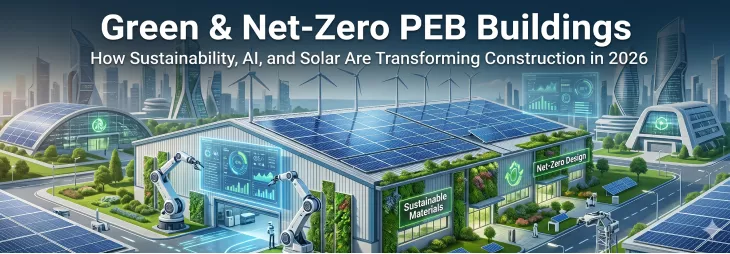
The construction industry is rapidly evolving as businesses focus more on sustainability, energy efficiency, and smart infrastructure. In 2026, industries have evolved to a point where they no longer use traditional concrete constructions but have opted for quicker, intelligent, and sustainable construction materials. This trend has necessitated more demand for pre-engineered metal buildings in manufacturing, warehouses, logistics centers, and other commercial properties.
Furthermore, the current industries are under pressure to reduce their carbon emissions and control their operational costs. This means that environmentally friendly construction processes are becoming increasingly relevant in industries looking to embark on new ventures. The PEB structures are assisting companies in creating future-proof facilities with enhanced energy efficiency.
What are pre-engineered metal buildings?
A pre-engineered metal building is a steel structure that is prefabricated and erected on-site. This type of construction differs from conventional construction as they use precision-engineered components that reduce construction time and material waste. The reason why most companies go for pre-engineered metal building systems is that they are flexible, easier to install and need less maintenance.
Such buildings are usually utilized for warehouses, factories, cold storage facilities, airports, commercial buildings, and logistics centers. The most important advantage is that they are scalable. It means that there will be no problem expanding or changing the building in the future.
Why sustainability is reshaping construction in 2026
Sustainability is no longer an optional feature in industrial construction. Governments, investors, and businesses are focusing on environmentally responsible infrastructure that reduces energy consumption and carbon emissions. Conventional construction practices are usually characterized by high levels of material usage, production of more waste, and greater impacts on the environment.
On the other hand, sustainable pre-engineered steel buildings incorporate aspects of recyclability of materials, minimization of waste, and energy efficiency. Industrial plants have now been required to embrace sustainable practices even as they reduce their costs. This explains why there is an increased use of pre-engineered steel buildings by industries.
What makes a PEB building net-zero?
A net-zero building is designed to generate as much energy as it consumes. In industrial projects, this is achieved through a combination of renewable energy systems and energy-efficient building technologies.
Some of the green building structures include installation of solar panels on roofs, high-grade insulation systems, energy-efficient lighting systems, and natural ventilation techniques. The use of these elements minimizes energy requirements while at the same time improving the environment inside.
The current pre-engineered metal buildings are equipped in such a way that they are compatible with solar-ready roof systems, thus making it easy for the renewable energy systems to be integrated successfully. As industries move toward carbon-neutral operations, net-zero industrial infrastructure is becoming a major trend in 2026.
Is your industrial building ready for 2026?
The industrial buildings of 2026 will be smarter, more efficient, and eco-friendly. Any business considering constructing new buildings needs to consider if its infrastructure can cater to the requirements of the future.
Some characteristics that any future-ready industrial building must possess include:
- Solar ready roofs
- AI enabled energy management systems
- Smart ventilation systems
- EV charging
- Conserving water technologies
- IoT enabled operation management systems
- Efficient insulation systems
Buildings without these features may face higher operational costs and reduced energy efficiency in the future.
How AI is transforming pre-engineered steel buildings
Artificial intelligence is playing a major role in improving industrial building performance. AI-powered systems help businesses monitor energy usage, reduce equipment failures, and improve operational efficiency.
Today, many pre-engineered steel buildings are equipped with intelligent features that control lighting, air-conditioning, and ventilation according to occupancy and environmental conditions. Predictive maintenance systems ensure early detection of any problem in the machinery, resulting in decreased maintenance costs.
Intelligent project planning through AI helps achieve greater precision during construction and fewer delays. The intelligent analytics assist the organizations in assessing the performance of buildings and their energy usage in real-time. With growing technology adaptation, AI-driven industrial infrastructure is playing an increasingly significant role in sustainable construction planning.
Role of solar energy in green PEB buildings
Solar energy plays a key role in designing net-zero industrial construction. The roofs of industrial structures provide tremendous scope for installing solar panels helping businesses generate their own renewable energy.
Solar plants provide tremendous assistance in cutting dependence on traditional energy sources and in lowering monthly energy expenses. Many industries now implement battery systems to ensure energy efficiency during peak loads.
The modern-day pre-engineered metal buildings are made to easily accommodate solar power facilities due to their flexible structure and strong roof. When industries incorporate solar technology in their structures, they are bound to save money.
Traditional factory vs Green PEB factory
Traditional industrial facilities often consume more energy and require higher maintenance compared to modern green industrial structures.
| Traditional Factory | Green PEB Factory |
|---|---|
| High electricity bills | Solar-powered savings |
| Longer construction time | Faster project completion |
| High maintenance | Predictive AI maintenance |
| Poor energy efficiency | Smart energy optimization |
| More waste generation | Sustainable steel systems |
These benefits help businesses improve productivity while reducing environmental impact.
How different sectors are using green PEB buildings
Many industries are already adopting sustainable industrial infrastructure to improve operational efficiency.
Manufacturing Sector
Facilities that incorporate solar power will serve as an excellent strategy in lowering electricity costs and improving the sustainability of performance. AI-based monitoring systems also help optimize production-related energy consumption.
Warehouse & Logistics Industry
Large-span facilities with natural lighting and ventilation are beneficial to warehouses. It improves efficiency without using much energy.
Cold Storage Units
Energy-efficient insulation systems are needed in cold storage facilities. Steel-based structures can be used sustainably for minimizing cooling and energy costs.
EV Manufacturing Plants
Electric vehicles have adopted energy-efficient and solar-powered technologies to ensure sustainable carbon-free production processes.
Common myths about green PEB buildings
Many businesses consider sustainable industrial buildings to be costly and challenging to manage. However, modern green industrial buildings offer cost savings in the long run to justify their initial costs.
One common myth about industrial buildings is that steel buildings are not sustainable. In reality, steel is one of the most recyclable building materials for industrial buildings.
Some businesses assume that solar powered industrial buildings cannot support large businesses. But businesses can efficiently operate major activities using renewable energy sources due to advanced solar technology.
What will the smart factory of 2030 look like?
Future industrial facilities will be smarter, automated, and energy-efficient. Some of the features of the smart factory are expected to include AI-powered monitoring, automation-driven maintenance alerts, robotic-powered inspection, and incorporation of renewable energy technology.
The smart infrastructure will offer companies the capability to assess the effectiveness of operations on a real-time basis while optimizing the use of available resources. The sustainability of industrial facilities will depend largely on carbon reduction and energy independence. This trend has led to an increase in demand for pre-engineered metal buildings.
Build Future-Ready Industrial Infrastructure with A & M Group
The future of industrial construction is moving toward sustainability, smart technologies, and energy-efficient infrastructure. The businesses are now prioritizing construction methods that are fast, cost-effective, and eco-friendly in nature. With the help of advanced solar panels, AI-based monitoring systems, and sustainable designs, the pre-engineered steel buildings have gained immense popularity for industrial purposes.
A & M Group, a leading pre-engineered building manufacturer in Chennai offers innovative solutions for industrial buildings that cater to modern business needs. Focusing on sustainable planning and effective construction methods, we offer industrial buildings that will last for long-term operational growth.
Contact A and M Group. Build better, smarter, and sustainable industrial structures using our modern PEB construction techniques designed for the future.