
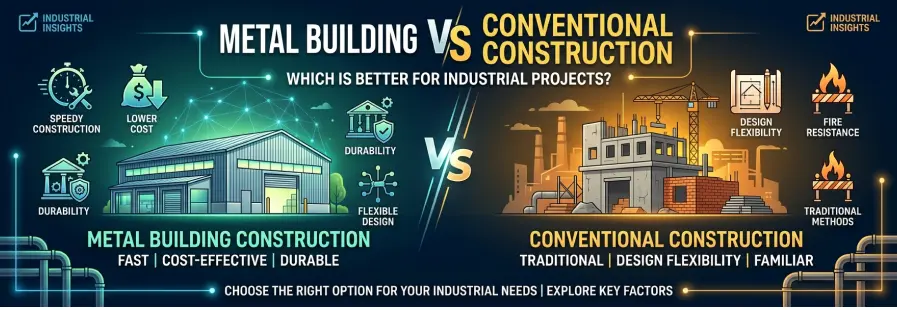
Anyone planning a factory, warehouse, or industrial shed runs into the same fork in the road eventually. Metal building, or stick with conventional construction? Both methods work fine. Both have been around for decades. But industrial projects come with their own set of demands, and once you dig into those, the answer tends to lean one way more than most people expect.
How the Two Construction Methods Differ
Conventional construction is brick, concrete, and cement work, built up layer by layer right there on-site. It's the method most people picture the moment someone says "building."
Metal building construction works differently. Steel components get fabricated somewhere else entirely, often as part of a pre-engineered system, then shipped and assembled on location. Less on-site labor. Less wet work involved. In a lot of cases, a structure that's up in weeks instead of months.
Neither approach is the wrong choice on its own. But industrial projects have specific needs, and that's where the real differences start showing up.
Speed Is Where the Gap Gets Widest
Conventional construction eats time. Foundation work, brick-laying, curing, plastering — each stage waits on the last one to actually finish, and a single stretch of bad weather can push everything back by weeks.
Steel building construction skips most of that waiting game. Components show up pre-fabricated and just get assembled, cutting out the sequencing conventional methods depend on. A 10,000 sq. ft. industrial shed that could take several months the conventional way sometimes wraps up in a matter of weeks with metal.
For businesses racing to get a facility running, this speed gap alone usually decides things.
Foundation Requirements: Not as Similar as You'd Think
Here's something that gets overlooked a lot: foundation work. Conventional construction needs a heavier, more extensive base, since brick and concrete carry a lot more dead weight. That means more digging, more concrete, and a longer wait for curing before anything can go up.
Metal buildings, being lighter across the board, usually get away with a lighter foundation. That doesn't make the engineering any less important — larger industrial spans still need it done right. But the reduced load generally means less excavation and a quicker jump into the actual structural work. On a tight timeline, this one detail alone can save weeks.
Which One Actually Costs Less?
On paper, conventional construction sometimes looks like the cheaper option upfront, particularly for smaller builds. But industrial projects rarely stay small, and that's exactly where the numbers start to shift.
Metal building construction cuts labor costs noticeably, since there's less manual work happening on-site. Material waste drops too, because steel arrives fabricated to spec instead of being cut and adjusted as you go. Faster completion means lower financing costs as well — the project isn't sitting half-built for months while interest quietly piles up.
Conventional construction can end up pricier over the full lifecycle once you add up longer timelines, more labor, and the ongoing maintenance a brick-and-concrete structure usually needs. Worth noting too — steel prices shift with the market, so the cost gap between the two isn't fixed; it moves depending on when a project actually gets priced.
Durability and Maintenance in Industrial Settings
Industrial buildings put up with heavy machinery, constant activity, and sometimes rough environmental conditions. Durability isn't a nice-to-have here.
Steel handles all that well. It shrugs off pests, doesn't crack the way concrete tends to over time, and holds up better under certain kinds of structural stress that industrial work throws at a building. Maintenance is more predictable too, since steel doesn't age the same unpredictable way brick and mortar do.
Conventional buildings aren't weak by any means, but they need more ongoing upkeep, especially in humid or high-moisture areas where concrete and plaster wear down faster. Coastal locations tend to speed up wear on both materials, though properly coated steel resists corrosion more reliably than untreated masonry facing the same conditions.
Layout Flexibility for Industrial Spaces
Industrial spaces usually need large, open floors without a forest of columns getting in the way of equipment or workflow. This is where metal building construction has a real structural edge. Pre-engineered steel systems can span wide distances without needing the column density conventional construction typically calls for.
That matters a lot for warehouses, manufacturing floors, and anywhere machinery movement or storage needs room to breathe. Conventional construction can hit similar spans too, just usually at a higher structural cost.
Metal buildings also handle future expansion better. Adding on to a steel structure tends to be more straightforward than extending a brick-and-concrete one, since the modular nature of pre-engineered systems is built for that kind of scaling.
When Conventional Construction Is Still the Better Choice
None of this makes conventional construction obsolete. For projects needing heavy masonry, specific architectural detail, or where local regulations lean toward traditional methods, conventional construction is still a solid pick.
Plenty of industrial facilities actually blend both — steel for the main structure, conventional construction for the office or administrative sections attached to it. Each method doing what it does best.
How to Choose the Right Industrial Building Contractor
Whichever route you go, the contractor matters just as much as the construction method itself. An experienced industrial building contractor understands the site-specific stuff — soil conditions, load requirements — that a generic quote usually glosses over.
For metal building projects specifically, a contractor who fabricates in-house, rather than outsourcing steel components, tends to give tighter quality control and fewer delays caused by third-party back-and-forth.
Common Mistakes When Choosing a Construction Method
- Deciding purely on upfront cost, without factoring in long-term maintenance and lifecycle expenses
- Assuming conventional construction is automatically more durable, without accounting for how steel actually performs under industrial conditions
- Underestimating just how much faster steel building construction gets a facility up and running
- Not checking whether a contractor manufactures components in-house or leans on third-party fabrication
- Ignoring future expansion plans when weighing a rigid conventional layout against a more adaptable steel one
Finding the Right Partner for Your Industrial Building
Whether you're weighing metal building construction against conventional methods, or you've already settled on steel, the contractor you pick determines how smoothly the whole thing actually goes.
A and M Group has been building industrial structures across Chennai and Tamil Nadu for over 12 years now, handling pre-engineered buildings, structural steel fabrication, mezzanine floors, and full site erection, all under one roof. Their in-house manufacturing facility spans 30,000 sq. ft. with a production capacity of 500 tons, which means every structural component gets fabricated and quality-checked internally instead of passed off to a third party. That kind of control over speed, consistency, and finish quality makes a real difference once a project gets large.
If you're still weighing metal building versus conventional construction for your next industrial project, bringing in one of the best metal building contractors in Chennai early in the planning stage can save both time and unnecessary cost further down the line.