
Industrial roofing is more than just a protective covering - it is a critical component that influences the safety, efficiency, and long-term performance of a facility. The two roofing systems that can be considered are trussless roofing and traditional roofing. Though both are meant to serve the purpose of protecting the industrial buildings from weather elements, there is a difference in terms of structure, installation process, and costs involved. This understanding will enable the industries to make a proper choice depending on their needs.
Having a partnership with an experienced PEB company in Chennai will make this choice easy for you. With proper professional advice, the industries will be able to select the right type of roof according to the requirements of the project.
Understanding trussless roofing
Trussless roofing is a relatively new roof technology which does not involve the use of the conventional truss framework. Rather, the metal sheets are made in such a way as to form self-bearing profiles and distribute the loads effectively.
The applications of the trussless roof include:
- Manufacturing units
- Warehouses
- Industrial sheds
- Logistics centers
- Aircraft hangars
- Agricultural warehouses
What is traditional roofing?
In traditional roofing, the use of trusses made up of steel or wood is necessary to hold the roof. The roof load will then be transferred to the column and foundations of the building through the trusses. This kind of roofing method has been extensively used for years in the construction of buildings.
The advantage of this type of roofing method is that it can be easily modified according to the size of the building and design. This method is usually chosen by those who have small building spans.
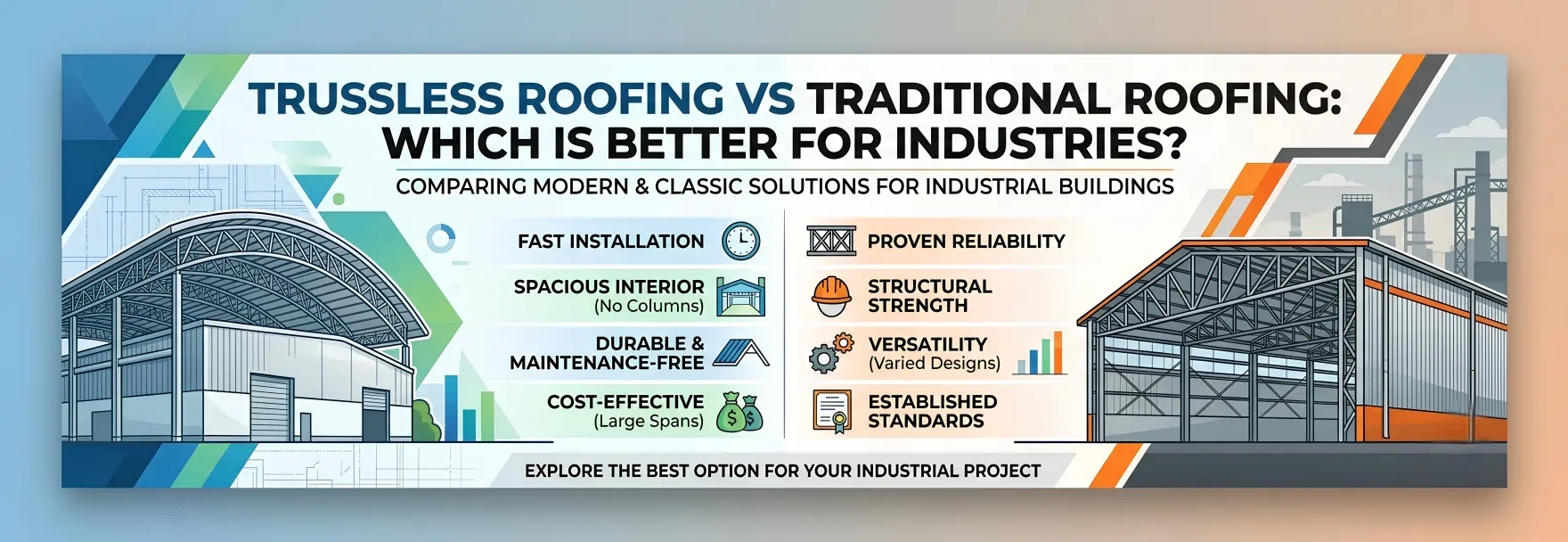
Trussless roofing vs Traditional roofing – A detailed comparison
Selecting between trussless roofing and traditional roofing involves several considerations such as project size, budget, operation needs, and future expansion. Knowledge of how the two roofing systems perform will make the selection easier.
| Feature | Trussless Roofing | Traditional Roofing |
|---|---|---|
| Structural Design | Self-supporting roof panels | Supported by steel or wooden trusses |
| Installation Time | Faster installation | Longer construction time |
| Material Usage | Requires fewer structural components | Uses multiple trusses and supports |
| Construction Cost | Can reduce overall construction time and labour costs | May involve higher structural and labour expenses |
| Maintenance | Lower maintenance requirements | Periodic inspection of trusses is required |
| Interior Space | A clear-span design offers more usable space | Internal trusses may reduce available space |
| Future Expansion | Easier to extend and modify | Expansion may require structural changes |
| Durability | Strong and designed for industrial applications | Reliable when properly maintained |
| Lifespan | Long-lasting with quality materials | Long service life with regular maintenance |
Both roofing systems offer unique benefits. Trussless roofs are always a favorable option for modern industries because they have features like efficiency and speed with large spaces. Conventional roofs are still an option in specific buildings with conventional structures.
Which roofing system performs better in different industries?
Every industry has its own operational needs, and thus there is no universal approach to roofing. Selection of a roof should be done taking into account various aspects like equipment setup, manufacturing process, storage requirements, etc. Comparison of different roofing systems according to their industrial applications gives an insight into their performance.
| Industry | Recommended Roofing System | Why It Works Best |
|---|---|---|
| Manufacturing Plants | Trussless Roofing | Large clear-span workspace |
| Warehouses | Trussless Roofing | More storage space |
| Logistics & Distribution Centers | Trussless Roofing | Fast construction and flexible layout |
| Food Processing Units | Trussless Roofing | Easy to maintain and hygienic |
| Textile Industries | Trussless Roofing or Trussless Roofing | Fits different space and budget needs |
| Agricultural Buildings | Trussless Roofing | Cost-effective for smaller structures |
| Workshops & Small Industrial Units | Trussless Roofing | Ideal for short-span buildings |
With regards to industries that have plans for future expansion, a pre-engineered building coupled with truss roofing will definitely be more flexible.
Why roofing sheets matter in industrial roofing
The performance of any industrial roofing system depends not only on its structural design but also on the quality of the materials used. Roofing sheets have a significant role in providing protection against the weather, increasing energy efficiency, and adding to the longevity of the industrial building.
Some of the widely used roofing sheets for industrial buildings are:
- Galvalume roofing sheets for excellent corrosion resistance
- Color coated steel sheets for improved strength and aesthetics
- Insulated roofing sheets for better thermal insulation
- High tensile metal sheets for robust industrial usage
Good quality roofing sheets add to the performance of the industrial roof and improve the indoor conditions for working by reducing heat and water leakage during the rainy season.
Benefits of choosing a pre engineered building
Many developments are made in the field of industrial construction in recent times, and most companies today consider the idea of having a pre engineered building due to the advantages of speed, efficiency, and flexibility.
Some other advantages include:
- Steel optimized for cost-efficient construction
- High manufacturing consistency
- Flexibility in building design
- Easy customization for a wide variety of industrial uses
- Low labor requirements
- Easy expansion in the future
The expansion of businesses is likely to be easier when done through a pre-engineered building.
When is traditional truss roofing the better choice?
Despite its growing popularity, trussless roofing is still considered an effective choice in certain scenarios. The ideal form of the roof will differ from one case to another depending on the needs of the project.
Some of the areas where traditional truss roofing is appropriate include:
- Small industrial spaces with a small floor space
- Structures without the need for large span widths
- Modification of already existing buildings
- Budget-oriented projects with standard construction procedures
- Workshops and storage rooms with smaller roof spans
Most of the old industrial buildings have been initially constructed with traditional trusses. During their modification and expansion, it can be more economical to retain the structure rather than installing a whole new roofing system.
How to choose the right roofing system for your industry
Selecting the right roofing system requires careful planning. Each and every industrial development has its own operational needs, and various aspects must be considered prior to making a decision.
- Building size: Ensure that you choose an appropriate roof depending upon the span and size of your building.
- Industrial operations: Consider the machinery and operations involved in your industry
- Expansion plans: Choose a roof which will allow expansion in the future
- Climate: Rainfall, wind, temperature, and humidity need to be taken into consideration
- Maintenance: It is best to use a roofing system that is consistent with your maintenance budget
- Project budget: Compare both the initial cost and operational expenses
Getting advice from professionals who specialize in roofing systems will help businesses in making a decision.
Why choose a trusted PEB company in Chennai?
Hiring the services of a reliable PEB company in Chennai guarantees that all parts of the process, from designing to selection of materials to installation and quality checks, are carried out in a perfect manner.
The advantages of choosing the right construction partner include the following:
- Customized industrial building solutions
- Good quality of roof materials
- Proper engineering and structures
- Industrial standards
- Effective project management
- Timely completion of projects
- Technical support
Professional guidance will help companies to invest in roofing systems that provide long-term value while supporting operational efficiency and future expansion.
Build stronger industrial spaces with the right roofing solution
The selection of either a trussless roofing system or a traditional roof system is a critical choice whose consequence will affect the performance, strength, and effectiveness of the industrial structure. Even though there are several benefits in trussless roofing with quick construction, wide spans, and easy to expand in the future, the traditional roof system is still a choice for small buildings with conventional structural specifications.
A&M Group is one of the leading PEB manufacturers in Chennai that designs modern industrial building structures to meet the demands of current industrial firms. Through experience and expertise in engineering, manufacturing, and project management, A&M Group helps industries build high-quality industrial structures.
Partner with A&M Group for customized industrial roofing solutions, premium roofing sheets, and expertly designed pre engineered building systems.